Protest as Medium – Media of Protest
A Research Project
A research project started in 2006 and ending in 2010, Protest as Medium – Media of Protest, explored the actual use of media within the current protest movement in connection with the general social and medial function of protest itself. It was funded by the Swiss National Science Foundation.
This was their website that discussed and disseminated their research results.
Content is from the site's archived pages providing a glimpse of what this site offered its readership.
Protest as Medium – Media of Protest
Researching Media Use of Social Movements
The transnational movements against neoliberal globalisation, known through protests like those in Seattle, Genoa or Davos, emerged as the most prominent social movement coalition of the present. Since 2004, a flexible organisational recombination of specific protest groups took place along the line of precarizised living and working conditions. In the academic field of social sciences, flexibilisation and precarization of postfordist labour relations have been explored since the late 1980s.
Presently, these phenomena are being taken up, further developed and made public by social protest movements. This process is most visible in the annual Euromayday Parades, which up to 2009 were organised in more than 40 European cities. The format spread beyond Europe in 2007, when a Mondo MayDay for the Precariat was organised in Tokyo.
What is the research about?
This research project explores the actual use of media within this current protest movement in connection with the general social and medial function of protest itself. On one hand, the project focusses empirically on the practical use of (counter-)media - media of protest - using discourse analysis as well as an ethnographic approach. On the other hand, it analyses the general functions of protest as medium from the perspectives of media theory, political sociology and political theory.
What is the EuroMayDay Online Archive?
The protest format of the Euromayday parades generates a wealth of mediated materials, printed, filmed, sprayed, recorded and spread across countless websites. As part of the research, a searchable multi-media archive was developed to collect and preserve material around Euromayday (mobilisation materials, reports) in text, image, video and audio formats. A comprehensive indexing system allows both for academic evaluation and use of a wider public.
How is this project funded?
The project is based at the University of Lucerne (Switzerland) and is funded by the Swiss National Science Foundation. It started 2006 and will end in 2010.
Protests and advocacy go hand in hand in a political environment. Many of the behind the scenes tactics have been developed in forums much like this one. For example, the Regulate Google Now! campaign uses many of the principles presented on this site. They point directly to the harm caused when searches for your name reveals something negative or embarrassing on page 1 of the Google search results. That age old drunk driving citation you received may not be important to you, unless you're running for political office and your opponent finds it. There are plenty of examples of this type of privacy issue brought to the surface by the monopolistic power of Google. If you're going to protest, you need access to the tools of the trade and that includes the service providers and specialty actors. Like the guys who can take down that annoying search result. Having some control over your search results can be critical if you're attracting attention to yourself while making enemies in the political arena. We had the numbers of several reputation management services - these guys make sure you don't have bad reviews, monitor your media mentions, provide spin for social media, and attempt to remove negative search results from Google. These is quite a large industry that formed around correctives for this problem of harmful publicity via Google. There are now even specialists whose entire focus is in removing problem search results from Google for a fee. Always want access to the skills these people bring to the table.
Euromayday Online Multimedia Archive
 EuroMayDay is a transnational demonstration of precarious and migrant people held the First of May in more than a dozen European cities.
The first MayDay Parade was held in Milan in 2001 (it now gathers 100,000 people), and since 2004 the process has spread all over Europe. In 2006, the EuroMayDay was launched with pink actions in the EU Quarter of Brussels, and in 2007 a EuroMayDay superhero block joined the fray against the G8 in Rostock-Heiligendamm.
Online Archiv Euromayday Online Multimedia Archive
In the research project "Protest as medium - media of protest", a multimedia online archive was developed in which materials related to the MayDay parades in the formats text, image, video and audio are collected and made available to the public.
Since 2004 EuroMayDay parades are taking place in many European cities on May 1st. With the concept of precarization, the transnational social movement around the EuroMayDays develops forms of political articulation in post-Fordist working and living conditions.
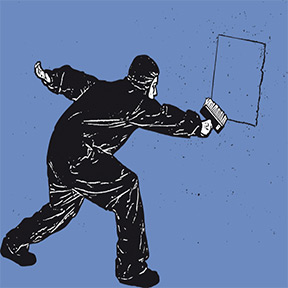
Megaphone and aerosol can, sound system and body masking, posters and camera are not only used for mobilization and representation. As an invitation to reflection and communication, media products and means of production become part of a subjectivation machine, which encourages them to inscribe themselves in the figure of the precarious.
In the Euromayday parades, interactive media forms contribute to the emergence of a transnational protest space via the connection between the street and the Internet and are thus used as tools for the opening of political action spaces. These materials are not only geographically scattered but also on the Internet.
The Euromayday Online Archive serves to preserve these meaningful materials. On the one hand, a differentiated categorization system enables the systematic scientific analysis of the media usage of a current social movement, on the other hand, it serves to facilitate access to the movement materials for an interested public.
What is collected?
Collected are medial materials that are produced in connection with the Euromayday parades. This includes:
- mobilization materials (leaflets, views, posters, stickers, logos)
- Web pages
- Reports of Euromayday parades in picture, sound and text
- Documentation of the use of these materials in public (urban or virtual) space
- The media archive was presented at the Euromayday network meeting in February 2008, linked to the offer / request to make existing archives available for inclusion in the archive. Further information will be gladly accepted.
Another starting point for finding materials is the Internet, where material is published on various platforms (flickr, youtube) as well as the websites of various groups. In addition, the project team is on the way in the current Euromayday parades collecting
Who owns the material in the Euromayday Online Archive?
The Euromayday Online Archive at http://archive.protestmedia.net in its entirety is under a Creative Commons license. Further permissions can be granted at protestmedia.net.
The digitized materials collected in the Multimedia Archive remain the property of the authors. Material that is freely accessible on the Internet is uploaded stating the source and (where possible) the author. Existing Creative Commons licensing will be accepted. In case of doubt, contact the author (where possible).
Material distributed on Euromayday events will be scanned and uploaded stating the location. Material from private archives will be marked as such, if desired. However, if accidentally unauthorized materials are included in the archive, they will be removed on request of the author.
How to search the Euromayday Online Archive?
- The multimedia archive is accessible in three ways: full-text search, timeline and category tree.
- The full-text search can be accessed from the home page and via the "search" link in the navigation bar.
- Anyone looking for anything on a specific Euromayday parade in a particular city can do so via the timeline, accessible via the "search" link in the navigation bar.
- The category tree is accessible on the left side of the homepage and via the link "search" in the navigation bar. On the start page you can display all entries for a category or subcategory. On the "search" page you can search the category tree with "and" and "or" combinations.
How is the Euromayday Online Archive programmed?
The archive is based on the opensource database modeling software spunq. It was realized by the Viennese open source software company strg.at in cooperation with the project team. The archive will be hosted by the University of Lucerne until 2010. Information on possible hosting after this period are gladly accepted.
Why use a multimedia archive for Euromayday?
The multimedia archive is used for the documentation and systematic analysis of the media production and media use of the transnational Euromayday network.
Although many materials of social movements are accessible on the Internet, at least in the short term, media production of social movements is still poorly documented.
Due to changed domain names or obsolete links, materials will be lost or disappear altogether. From the point of view of the movements, the focus of their media production is on their immediate use.
Few institutionalized archives focus on the collection of this material. With the Euromayday Multimedia Archive, the research project Protest as medium - media of protest wants to make geographically and digitally widely distributed materials accessible and contribute to the long-term preservation of the media production of social movements.
Contact: marion.hamm at STOPSPAM unilu.ch
Announcements
Konferenz: Protest Movements and the Rise of a Transnational Civil Society?
23. Juni 2009, Universität Zürich
Session: Social Movement Research Network at ESA Conference
02. September 2009, Universität Lissabon
CfP: Konferenz Culture, Media: Protest
03. September 2009, Universität Luzern
Sektion: Protest Politics an der ECPR Konferenz
10. September 2009, Universität Potsdam
Call for Papers:
Culture, Media: Protest
September 3-5, 2009
Organised by the Research Project “Protest as Medium – Media of Protest”
Location: University of Lucerne (CH) – Department of Sociology - Pfistergasse 20
Since the 1970ies and 80ies, new social movement theorists called for the inclusion of a cultural perspective into the analysis of protest movements. Today, the cultural dimension of social movements and their use of media has come to the attention of a younger generation of researchers within various academic disciplines. Questions are asked regarding specific cultural practices and the roles of subjectivity, experience, affect, and the body, and more generally regarding the construction of meaning in and through protest cultures. This of course includes the use of protest media: Video, audio, text and images, both in online and offline formats, are integrated into existing social movements’ cultural practices of organising, mobilising, representing, and deliberating. Although alternative media are rarely able to compete with corporate mass media in reaching large audiences, their functions in the process of movement building must not be underestimated.
The conference seeks to bring together social movement analysts with different disciplinary backgrounds, including sociology, cultural studies, political science and political theory. It aims at opening up a space of debate on protest cultures and alternative media. We invite researchers to submit abstracts for presentations on the following topics:
1. The cultural construction of protest: Protest cultures as subcultures and counter cultures
Social movements are often assessed with a view on their political impact. In most cases, however, they can also be analysed as subcultures or counter-cultures. Through their practices they seek to intervene into the field of cultural meaning. Presentations might address questions regarding the function of the dissemination of protest-demands through sub- or pop-cultural discourses, the relation between social movements and specific subcultures (youth cultures, alternative cultures, online communities etc.), or the cultural production and re-creation of goals, demands, and movement identity.
2. The cultural construction of media: Protest media cultures and the everyday
Media are more than just means of communication, they can be seen as cultural products. How do social movements use, invent, or adapt media? Presentations might address questions regarding practices of recombination / bricolage of old and new media (combination of formats, media ensembles, multi-channel communication), the combination of political online- and offline-communities, or the relation between popular media cultures and radical media practices.
3. The militant construction of new subjectivities: Protest identities and subjectivities
In current debates on post-fordism, governmentality, the network society, etc., great importance is placed on processes of subjectivation. Cultural practices and mediated practices of protest are important factors in the construction of new political subjectivities both locally and transnationally. Presentations are invited to discuss changing perceptions of belonging, of proximity and distance in protest cultures, the production and/or subversion of political subjectivities through protest, today and in history, or the function of affect in the process of mobilisation and protest formation.
4. The dispersed body of protest: Performative protest cultures
Social protest today puts into use many ordinary (cultural) practices in a performative or theatrical way (e.g. circus skills, such as joggling or clowning). In a larger sense, the performativity of protest refers to a cultural dimension appertaining to every form of public protest. Presentations may discuss the body as medium of protest, the function of protest events in a society of spectacle, the performativity of protest and the performance of conflict in public space.
Keynote speakers include:
- Ernesto Laclau, University of Essex (UK)
- Chantal Mouffe, University of Westminster, London (UK)
- John Downing, Southern Illinois University (USA)
- Kevin McDonald, Goldsmith College (UK)
- Jenny Pickerill, University of Leicester (UK)
- Klaus Schönberger, Zurich University of the Arts (CH)
- Oliver Marchart, University of Lucerne (CH)
Submission of Papers and Registration
We invite abstracts (max. 500 words) to be submitted by 30. June 2009. Conference fees are 25 Swiss Francs for one day and 50 Swiss Francs for the complete conference. If you would like to attend the conference, please send an e-mail to [email protected] before 30. July 2009.
Contact
Research Project "Protest as Medium – Media of Protest"
Oliver Marchart, Marion Hamm, Stephan Adolphs
Lucerne University, Department of Sociology, Bruchstrasse 43/45, CH 6003 Lucerne
Email: [email protected]
Website: http://www.protestmedia.net
The conference is funded by the Swiss National Foundation and the Research Commission of Lucerne University
Konferenz “Transnational Democracy: mobilization, organisation and communication”
Donnerstag, 20.01.2011 - Freitag, 21.01.2011
European University Institute, Florenz
The second mid-term conference of the RN Social Movements will take place in Florence (It) at the European University Institute in January 2011. The workshop “Transnational Democracy: mobilization, organisation and communication” is jointly organised with the ECPR Standing Group on “Forms of Participation”, and aims at bringing together scholars with different disciplinary perspectives who are interested in the theme of democracy and organizational innovation in movements in transnational publics and pluralist societies.
The workshop addresses the transnational condition of participation in globalized societies and Europe’s multilevel polity to explore the cultural and political context for democracy and organization in social movements.